"Employers are free to lawfully operate an enterprise
and the poor and unskilled workers are (generally) free to exit the circumstance by
quitting. However, the choice between deplorable work conditions or economic
destitution does not constitute real freedom or liberty."

Showing posts with label Learning the Business of Fashion. Show all posts
Showing posts with label Learning the Business of Fashion. Show all posts
Sunday, December 1, 2013

Monday, November 11, 2013
The Trouble with Second-Hand Clothes
 |
| The Trouble with Second-Hand Clothing |
This is a really good article from the Business of Fashion today. We really need to understand just how little clothes is re-sold by Oxfam in the UK, versus how much is sold to Africa. The book 'Salaula' by Karen Tranberg Hansen found that the donation of clothing isn't necessarily only a charitable action. There are evidince to argue that the development of an African apparel industry has been stalled because cheap second-hand clothing is so readily available. This then leads to the problems that TK Maxx for instance face in their CSR department in preparation for Red Nose Day: they have African organically grown cotton available, but can't find a supplier to produce the t-shirts. ASOS.com and SOKO also have issues sourcing fashionable garments for their ASOS Africa collection and have had to import fabrics to Uganda (Boodhna & Buxton 2013 [PDF]).
So if you want to donate your unwanted clothing consider why you need to get rid of it? Is it a mistake buy? Did you really use it until it was unwearable and why can't you mend it? Would others find it useful or should it go to the landfill? You should really try to keep your clothes in use - eBay, clothes-swaps and hand-me-downs are the ultimate ways to empty out your wardrobe. You should always try to mend and decorate your clothing so it stays alive and fresh in your mind so you'll keep wearing and cherish it. I find that the longer I try to keep clothes for longer the more I learn about which stitches last and what fabrics work and which just dishevel after a day. I personally find polyester super uncomfortable, but according to research from WRAP polyester fabrics and blends last longer and are therefore more sustainable than natural fibres (WRAP 2013).
So, buy less, mend more and friends before donations!
Tuesday, May 14, 2013
What has the Rana Plaza collaps taught us?
When the Rana Plaza factory complex in Bangladesh collapsed on April 24 media attention was finally drawn to the horrible working conditions of the garment industry. The knowledge is spreading with headlines in the major newspapers and finally friends of mine who have never considered where their clothes from, sign the Change petition and some ask me what they can do. The attention to the long-standing problem is great and we need to create momentum now that we have the attention of the media.

Some of the most disturbing factors surrounding the incident is that the entire first floor which functioned as a shopping mall was evacuated the day before. The risk was evidently known by the factory owners, but a pressing order was in production and the deadline had to be met. Furthermore, two of the factories in the complex were certified by BSCI and one by SA8000. BSCI is not a very well-known certification, but it covers working conditions and worker's rights. They both certify against child labour, forced labour and a legal minimum wage. Therefore they use the argument that their certifications are not designed to cover building integrity, however, when two days before the building was condemned unsafe, the factory owners forced the workers to continue working with the threat that by leaving they would give up their wage for the month.
Now comes the big question, what have we learnt from this and what will we do to prevent such disasters from happening again? Many are calling for industry leaders to make suggestions, including BSCI and EFF. The Accord on Bangladesh Fire and Building Safety is a great answer to this question. All certifications up until now are privately held, this one is legally binding. Adding to that it makes it a requirement that brands make their audit reports publicly available. This is a ground-breaking idea which would set Bangladesh apart from any other country. The garment industry is audited time and time again, several times a year by every company that they supply, but the heaps of information is kept secretly in the databases of the companies and their auditors. What if a company was legally bound to act upon or report unsafe working environments to the local authorities? What if the information gathered could be looked over by the National Garment Workers Federation?
The things to take with us from such a disaster is that auditors close their eyes to the real dangers. The factory owners and the powerful buyers with the pressing orders are the decision makers in instances like this. It is crucial to doubt certifications, even the ones we love - like fairtrade and organic certifications of coffee and cotton. Shirahime is a new blog that I have just found, who in this blogpost shares some gruelling facts about the certification system. We need to make a paradigm shift away from private for-profit certification systems whose auditors are paid for by the authority itself and change our perception of the problem.
The issue is just as much the issue of ourselves and our governments as it is a problem for Bangladesh/China/Vietnam/India/etc. By trading with these countries we move problems of labour safety away from our own country and into the world marketplace. The globalised world marketplace becomes our territory.
We need to make a revolution in the mindset of the entire supply chain of the fashion industry. Not only the CSR board need to understand the importance of fire safety, working conditions and living wage. The buyers, merchandisers, factory owners, factory production managers and the supervisors of the seamstresses need to understand that foreign money should raise the bar for pay, working conditions and thereby the living standards of everyone implemented. Their own governments encourage and lobby for these investments under the hope that the country's economy will improve and poverty decrease. But if the money stays with the rich that just won't happen.
Read more of the Clean Clothing Campaign's extensive coverage here and sign their petition to urge brands who source in Bangladesh to sign the Fire and Safety Agreement and make the brands who placed orders with the factories involved compensate for their loss.

Some of the most disturbing factors surrounding the incident is that the entire first floor which functioned as a shopping mall was evacuated the day before. The risk was evidently known by the factory owners, but a pressing order was in production and the deadline had to be met. Furthermore, two of the factories in the complex were certified by BSCI and one by SA8000. BSCI is not a very well-known certification, but it covers working conditions and worker's rights. They both certify against child labour, forced labour and a legal minimum wage. Therefore they use the argument that their certifications are not designed to cover building integrity, however, when two days before the building was condemned unsafe, the factory owners forced the workers to continue working with the threat that by leaving they would give up their wage for the month.
Now comes the big question, what have we learnt from this and what will we do to prevent such disasters from happening again? Many are calling for industry leaders to make suggestions, including BSCI and EFF. The Accord on Bangladesh Fire and Building Safety is a great answer to this question. All certifications up until now are privately held, this one is legally binding. Adding to that it makes it a requirement that brands make their audit reports publicly available. This is a ground-breaking idea which would set Bangladesh apart from any other country. The garment industry is audited time and time again, several times a year by every company that they supply, but the heaps of information is kept secretly in the databases of the companies and their auditors. What if a company was legally bound to act upon or report unsafe working environments to the local authorities? What if the information gathered could be looked over by the National Garment Workers Federation?
 |
| Firoz Ahmed: the National Garment Workers Federation campaigns for safer work environments. |
The things to take with us from such a disaster is that auditors close their eyes to the real dangers. The factory owners and the powerful buyers with the pressing orders are the decision makers in instances like this. It is crucial to doubt certifications, even the ones we love - like fairtrade and organic certifications of coffee and cotton. Shirahime is a new blog that I have just found, who in this blogpost shares some gruelling facts about the certification system. We need to make a paradigm shift away from private for-profit certification systems whose auditors are paid for by the authority itself and change our perception of the problem.
The issue is just as much the issue of ourselves and our governments as it is a problem for Bangladesh/China/Vietnam/India/etc. By trading with these countries we move problems of labour safety away from our own country and into the world marketplace. The globalised world marketplace becomes our territory.
We need to make a revolution in the mindset of the entire supply chain of the fashion industry. Not only the CSR board need to understand the importance of fire safety, working conditions and living wage. The buyers, merchandisers, factory owners, factory production managers and the supervisors of the seamstresses need to understand that foreign money should raise the bar for pay, working conditions and thereby the living standards of everyone implemented. Their own governments encourage and lobby for these investments under the hope that the country's economy will improve and poverty decrease. But if the money stays with the rich that just won't happen.
Read more of the Clean Clothing Campaign's extensive coverage here and sign their petition to urge brands who source in Bangladesh to sign the Fire and Safety Agreement and make the brands who placed orders with the factories involved compensate for their loss.
Monday, May 13, 2013
The turn of a grim Monday
Today felt pretty grim in a proper Monday mood until I went swimming in the Lido and felt a little better about the world - and then I sat down in front of the computer to find that a major reform of the Bangladeshi labour laws is about to start and now I feel like it's the best day in a long time.
To me it seems that finally the global attention towards labour issues have given the NGWF the power to pressure the Bangladeshi government into talks of raising the minimum wage. The retailers are in defence and any comment or lobbying against would be of interest to the media - meaning that the power is finally distributed in favour of the workers. H&M actually signed the Bangladesh Fire and Building Safety Agreement - pushing Primark and several others who had previously refused because they can't afford to pay for the factory buildings upgrading work into safe working environment. (Either it tells you something about the state of these buildings and what the retailers know about that, or it tells you just how greedy they are).

It has been announced that the minimum wage will be raised (currently at $37), which is roughly half of what it is even in India (Rs. 2500 vs. India: Rs. 4500). It is extremely important that we help press for the biggest increase possible and that the new freedom in joining unions is praised so that factory owners and the middle management understand that there is industry support behind their government's laws.
Important times are ahead of the NGWF and any consumer interested in raising living and working conditions of the 4.5 million workers in the Bangladeshi garment industry. Let us all show our support and hope that the momentum will build and spread.
Source: NyTimes, Jim Yardley
To me it seems that finally the global attention towards labour issues have given the NGWF the power to pressure the Bangladeshi government into talks of raising the minimum wage. The retailers are in defence and any comment or lobbying against would be of interest to the media - meaning that the power is finally distributed in favour of the workers. H&M actually signed the Bangladesh Fire and Building Safety Agreement - pushing Primark and several others who had previously refused because they can't afford to pay for the factory buildings upgrading work into safe working environment. (Either it tells you something about the state of these buildings and what the retailers know about that, or it tells you just how greedy they are).

It has been announced that the minimum wage will be raised (currently at $37), which is roughly half of what it is even in India (Rs. 2500 vs. India: Rs. 4500). It is extremely important that we help press for the biggest increase possible and that the new freedom in joining unions is praised so that factory owners and the middle management understand that there is industry support behind their government's laws.
Important times are ahead of the NGWF and any consumer interested in raising living and working conditions of the 4.5 million workers in the Bangladeshi garment industry. Let us all show our support and hope that the momentum will build and spread.
Source: NyTimes, Jim Yardley
Sunday, May 12, 2013
Webinars and other events worth tuning in on
Webinars seem to be the newest craze for businesses to spread information about sustainability. In this summary of events for the following weeks and months of sustainability and ethical fashion events there's an overweight of webinars. Here's a few of the ones I'm looking forward to.


Textile Exchange Collaborative Learning Series - Topic 3 Holistic Value Chains
May 13 or 14. This one is a great perk I get for working at a member company of the Textile Exchange. Last session on sustainability measurements was very interesting and I'm sure this one will be too. The conversation will be on how vertically integrated textile businesses benefit from a shorter and more secure supply chain. There's a cost if you're not a member, check it out here.
Accenture Sustainability24 - one day to set the future for business
May 15. This global broadcast is a 12-hour marathon of industry-wide discussions on sustainability including titles such as "Driving business growth while solving the global food challenge" and "Circular business: Value Generation in a resource constrained world". Panels will consist of senior executives based in the 12 chosen business hubs around the world. It may be clever marketing, but it's great insight into how big business think and talk about sustainability. I'll be listening in on the following sessions:
- Sustainable Consumption: Engaging Tomorrow's Consumer
- Sustainable Supply Chain: Why it is Good Business
- Innovative Business Growth: How Sustainability is Reshaping Businesses for the Future

Register yourself here. It's totally free and so far I haven't had to sign up to any irrelevant newsletters.
Better Lives lecture series at London College of Fashion
My university have just recently appointed a psychologist who has put together this series of lectures exploring the link between fashion and psychology. Over the course of 4 free lectures held at the Oxford Circus building leading psychologists are brought in to discuss fashion's impact on our well-being with the researchers at the Centre for Sustainable Fashion. You can read more and register here.

Source Summit: Momentum
Following the Bangladesh building collapse the different ongoing campaigns to raise awareness of the working condistions in sweatshops across the developing world have finally received the attention they deserve. However, building momentum is a challenging task that this Source Summit will focus on. How can we accelerate the momentum created around this incident and ensure that sustainable fashion becomes larger than a fad? The event is expensive, but considering the influence of the Ethical Fashion Forum members and the programme there is no excuse to miss this highlight in the ethical fashion calendar. Read more.

Monday, April 8, 2013
Women hit back at India's rape culture
Being in India in that crucial period while the 23-year-old medical student was gang raped and struggling for her life in hospital was an experience that will stay with me forever. The general righteousness and fairness that i expect to meet in life is a prerogative. My sense of security in life stems from the fact that I was born and have grown up in a Western society where the law is reality. So many women live in a society where even if they do have the right of sexual consent or reproductive rights, the society or police will not act upon allegations with due respect to the woman.

This is the story as I've gathered it from BBC and general articles around: The case of the student in the Delhi-rape was that she and her friend were walking around looking for an auto (tuk-tuk) outside the biggest mall Select City-Walk. Seeing as they were going far none of the drivers were willing to take them. This type of night time haggling is a pastime that you will end up spending a lot of time on if you decide to live in Delhi. Then they jump onto a bus - the decision that turned out to be the worst thing they could do. The driver had simply invited his friends for a ride after hours. It was a mistake of the couple to jump on that bus, and it was awful what those psychos did to her. But the awful thing doesn't end when they are kicked out of the bus. The scary part was for me to realise that naked, beaten up and blood streaming down their bodies they were running around the streets looking for help and not finding any. Auto's, taxis, trucks, people in their shiny white cars all refused to help them get to a hospital.
Getting involved in a case like this would take up your time and money - you could end up being suspect if you don't pay enough bribes with the way the Indian justice system malfunctions. When finally they manage to get hold of the police, the poor incompetent officers had to decide which hospital to bring the couple to. Because of the bureaucracy involved they couldn't bring her to the nearest (private) hospital, but had to take them to a propped government hospital with a queue that didn't exactly help getting her to a doctor any faster. The story shows that not only are there too many rapes happening in Delhi, but there is a profound fault with the justice system and bureaucracy involved even in emergencies.

The amazing thing that happened after the sad death of the victim December 29th was that women of all backgrounds started caring. They joined forces and told the men that they would no longer accept the treatment as sex objects any longer. I experienced how men would stare, lick their lips in lust and grope my privates as I passed by. I learned to lower my eyes and by New Years Eve I was prepared for the party scene in Goa where we accidentally ended up in a not-so-touristy club with way too many men. Twice in the first 15 minutes on the dancefloor i managed to grab the arm touching my ass and hit the guys. I seemingly got respect from that and as far as I remember the strangers left me to dance the night away with my friends.
The Red Brigade is a group of women in Lucknow who has gathered to end sexual harassment and abuse by learning self-defence and exercise punishment of the local men. Now, I'm not in favour of taking the law into your own hands as the Red Brigade do when they beat up men. But upon the realisation that the police really is corrupt, that the legal system does not function and this is the only realistic option for these women I have come to the conclusion that it has to be the way of India's women. Women in India need to prove their strength and unison. Until the legal and bureaucratic system gets fixed, physical come-backs and threats will have to educate the men of India on women's worth.
Speaking of rights and in the terms of third wave feminism will not help in India. India will go through their own waves of feminism, and all feminists in the west can do is to look at this in awe and write long blogs about it. We can show our support and facilitate learning, but it's their own fight with a part of their own culture that we can only try to understand. The women need to learn their rights and the men who don't get it need to be retaliated upon. It's a fantastic new era for these women and their daughters.
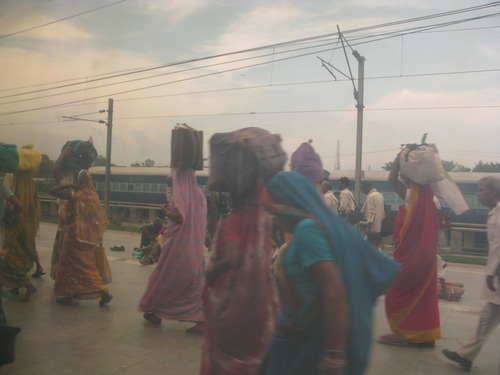
This is the story as I've gathered it from BBC and general articles around: The case of the student in the Delhi-rape was that she and her friend were walking around looking for an auto (tuk-tuk) outside the biggest mall Select City-Walk. Seeing as they were going far none of the drivers were willing to take them. This type of night time haggling is a pastime that you will end up spending a lot of time on if you decide to live in Delhi. Then they jump onto a bus - the decision that turned out to be the worst thing they could do. The driver had simply invited his friends for a ride after hours. It was a mistake of the couple to jump on that bus, and it was awful what those psychos did to her. But the awful thing doesn't end when they are kicked out of the bus. The scary part was for me to realise that naked, beaten up and blood streaming down their bodies they were running around the streets looking for help and not finding any. Auto's, taxis, trucks, people in their shiny white cars all refused to help them get to a hospital.
Getting involved in a case like this would take up your time and money - you could end up being suspect if you don't pay enough bribes with the way the Indian justice system malfunctions. When finally they manage to get hold of the police, the poor incompetent officers had to decide which hospital to bring the couple to. Because of the bureaucracy involved they couldn't bring her to the nearest (private) hospital, but had to take them to a propped government hospital with a queue that didn't exactly help getting her to a doctor any faster. The story shows that not only are there too many rapes happening in Delhi, but there is a profound fault with the justice system and bureaucracy involved even in emergencies.
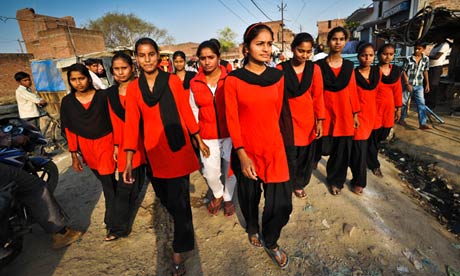
The Red Brigade is a group of women in Lucknow who has gathered to end sexual harassment and abuse by learning self-defence and exercise punishment of the local men. Now, I'm not in favour of taking the law into your own hands as the Red Brigade do when they beat up men. But upon the realisation that the police really is corrupt, that the legal system does not function and this is the only realistic option for these women I have come to the conclusion that it has to be the way of India's women. Women in India need to prove their strength and unison. Until the legal and bureaucratic system gets fixed, physical come-backs and threats will have to educate the men of India on women's worth.
Speaking of rights and in the terms of third wave feminism will not help in India. India will go through their own waves of feminism, and all feminists in the west can do is to look at this in awe and write long blogs about it. We can show our support and facilitate learning, but it's their own fight with a part of their own culture that we can only try to understand. The women need to learn their rights and the men who don't get it need to be retaliated upon. It's a fantastic new era for these women and their daughters.
Thursday, April 4, 2013
H&M Conscious Talk
Really can't believe I missed this talk. H&M are buzzing with energy after they've just opened the new & Other Stories shops and really driving the promotion of this season's Conscious Collection.
You can follow the links in the box above to watch the talk that happened this morning. I won't have time to watch it until the weekend (I really do miss student life from time to time). I will probably return with some comments.
You can follow the links in the box above to watch the talk that happened this morning. I won't have time to watch it until the weekend (I really do miss student life from time to time). I will probably return with some comments.
Thursday, March 21, 2013
Growing Communities
I've been meaning to post this for such a long time. We just got our third veg box/bag from Growing Communities with loads of fresh organic veggies. The bag has gotten better every week with basic things like potatoes, onions and carrots. Last week we had a stir-fry bag filled with funny leaves that I'd never tried before. The only one I knew was wild garlic, so I just chopped it all up and fried it with lotsa garlic, chilli and soy sauce - uhmm!

It feels really good to get veggies that still have dirt on them. It's so artificial that you literally can't see a sign of where supermarket vegetables come from here in the UK. I'm not saying it's much better in supermarkets elsewhere, but even in Greenland the potatoes have a little dirt left on them. It's also kind of scary to see how organics vegetables deteriorate so much faster than what you get from the shops. Our supermarket culture teaches us that courgettes can last a week or more, when really it starts shrinking and getting a little yucky after 2-3 days. The whole thing about tempered storage, reduced oxygen and extra carbon dioxide in the atmosphere around the green aisle and waxing makes an immense difference to our ways of treating food. We've come to expect these things rather than question how exactly those tomatoes from Chile made it all the way here and are still edible after a week.
Well, I also made it to the farmer's market in Stoke Newington a few weeks ago. There was a really nice atmosphere and all the stallholders were friendly answering my questions about weird breads and the possibility of finding some grains around.
.jpg)

My friend from back was visiting at the time, so I had a great time showing her around London. It was quite by surprise that we even found the market, but it's on every Saturday 10am-2.30pm. Maybe I'll see you there this Saturday?
The deets: The veg boxes that Growing Communities sell are by far the cheapest if you live around Hackney. In our flat it's quite helpful that we have 2 full days to pick up the bag rather than trying to make sure someone's home. There are so many nice places to pick up from - Hackney City Farm, cafés and green grocers. Next month I think we'll change to an organic grocery store so we can stock up on a few other good things at the same time. It's supposedly one of the benefits of (comparatively expensive) Abel & Cole that's there's a great pantry to choose from. The standard veg bag keeps our flat well stocked for the week, but then 1 out of 4 has been too stressed to cook slash away since we started on the scheme. The no pots bag is definitely worth considering if you're like the rest of our generation - pasta is just all we know, and we should admit it like Fred in Portlandia.
Well, I also made it to the farmer's market in Stoke Newington a few weeks ago. There was a really nice atmosphere and all the stallholders were friendly answering my questions about weird breads and the possibility of finding some grains around.
My friend from back was visiting at the time, so I had a great time showing her around London. It was quite by surprise that we even found the market, but it's on every Saturday 10am-2.30pm. Maybe I'll see you there this Saturday?
The deets: The veg boxes that Growing Communities sell are by far the cheapest if you live around Hackney. In our flat it's quite helpful that we have 2 full days to pick up the bag rather than trying to make sure someone's home. There are so many nice places to pick up from - Hackney City Farm, cafés and green grocers. Next month I think we'll change to an organic grocery store so we can stock up on a few other good things at the same time. It's supposedly one of the benefits of (comparatively expensive) Abel & Cole that's there's a great pantry to choose from. The standard veg bag keeps our flat well stocked for the week, but then 1 out of 4 has been too stressed to cook slash away since we started on the scheme. The no pots bag is definitely worth considering if you're like the rest of our generation - pasta is just all we know, and we should admit it like Fred in Portlandia.
Thursday, February 21, 2013
Phannatiq at Esthetica LFW
I cannot believe our house wi-fi decided
to disconnect just when I have loads of material queued up for the blog. I also can't believe I survived being internet-less for 48 hours. Phannatiq is a brand that I've been super eager to share since I met Anna
Skodbo at her Esthetica stall on Sunday.


Phannatiq is inspired by Hackney both on a great night out and the long walk home in the morning. The tights and
ready-to-wear collection are printed with scenes of metropolitan decay using
natural dyes. Like the origin of the dyes contrasts the urban motif, so do the
soft and feminine silk lengths contrast with the rawness of fig tree bark.


I ended up talking to Anna about the plant material used to create the yellow. Annatto is totally natural and we eat it is minuscule amounts every time we have cheese - so who's to say we shouldn't dye our clothes with it? I love the way the fabric has texture and colour depth / variance but is far from being tardy washed-out hemp. Click here to watch her SS13-film.
Sunday, February 17, 2013
Katrien van Hecke AW13 at Esthetica LFW
This season I totally forgot about fashion week until the last minute and threw myself into the mission of squeezing in some time for the Esthetica exhibition. Katrien Van Hecke is showing at LFW and Esthetica for the very first time. Her collection is a series of dresses and scarves made from her naturally dyed silks in the most beautiful hues of autumn.

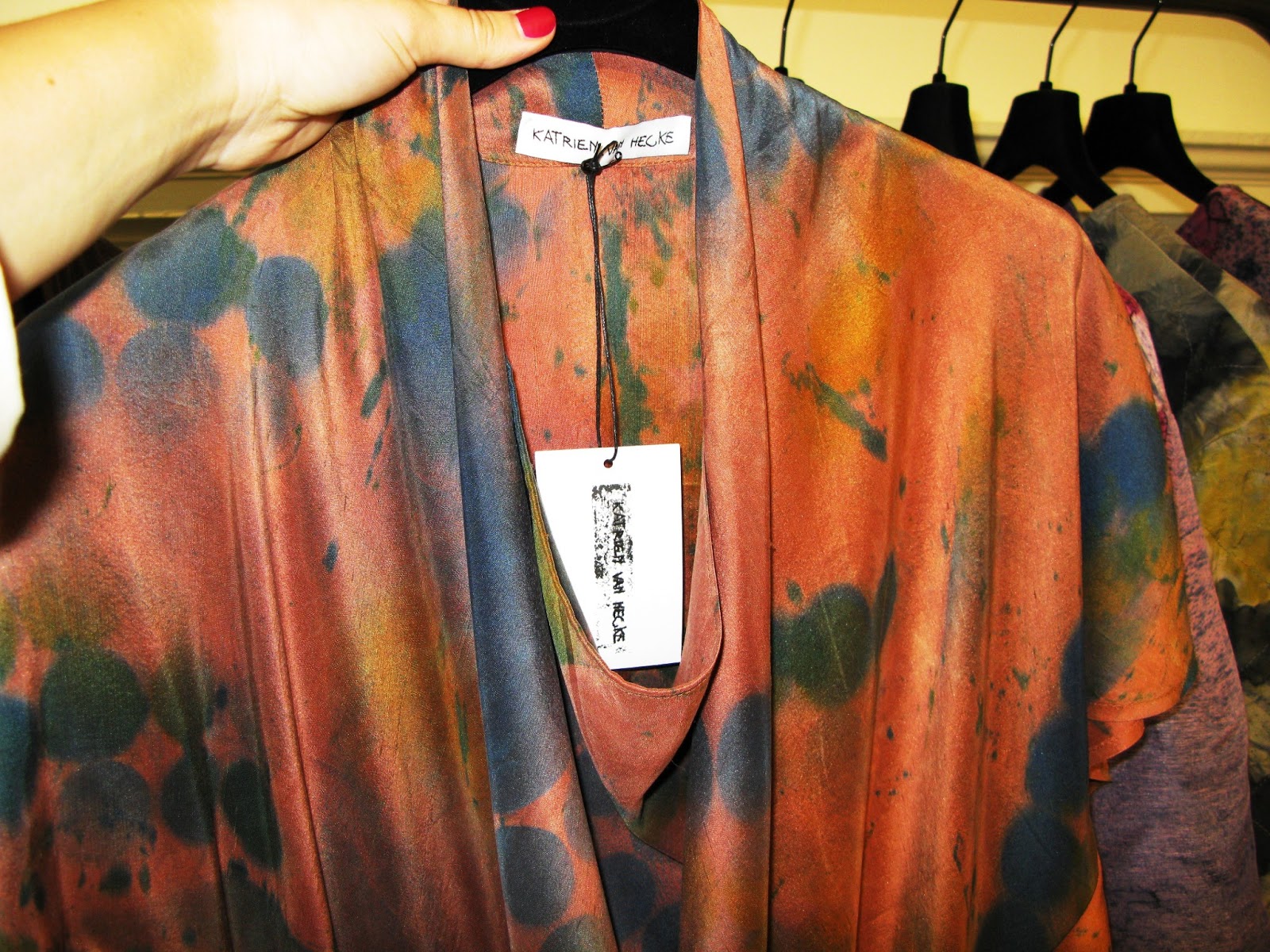


The detail in the natural randomness is like a beautiful sunset and I adore the way Katrien van Hecke manages to cut interesting pieces from large plain pieces of fabric in a way that makes them fall with shape. You can really see it from the quality of her work that she's worked with Hussein Chalayan. The simple cut makes the print centre of attention and as she expresses it in an interview with White Blog:
...I create my own language starting from plain, pure fabrics, threads or fibres that I paint and sculpture into clean, clear images...
Tuesday, February 12, 2013
LFW events to go to
Tomorrow you can catch a talk at Pure London. Safia Minney of People Tree will be there. I haven't seen/heard/met her before so I think that would be quite interesting (but guess who's got a 9-5 job now). Wednesday there's an Intelligent Futures event called 'Social Media and OpenData for CSR' presentation at the Google Campus.
During LFW itself there's of course the great Esthetica at the exhbition area where all the best ethical and sustainable designers showcase their newest collections. Hopefully they'll all gain loads of buyers and press coverage. Christopher Raeburn is the only designer in the official show programme. It's going to be exciting to see what he's come up with.
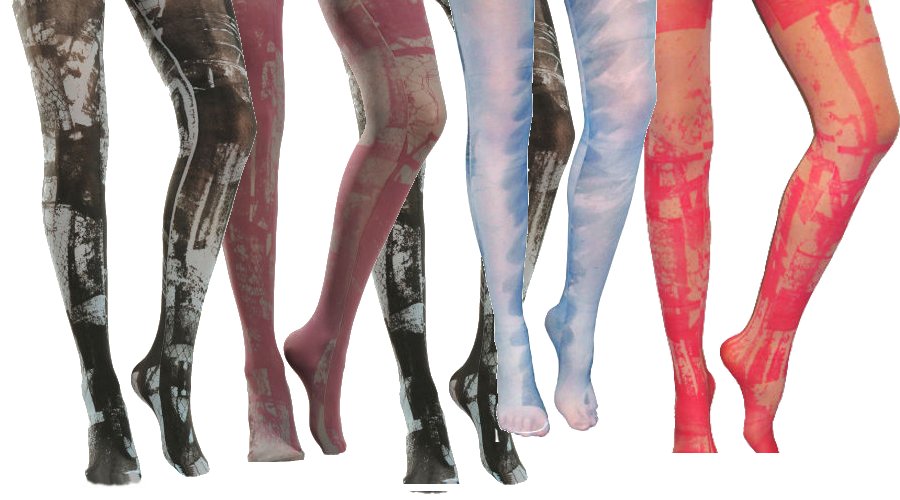 |
| Phannatiq is one of the new exciting designers at Esthetica. |
 |
| From Belgian Katrien Van Hecke's AW12
On Sunday and Monday Ecoluxe returns with a showcase of more than 20 responsible designers in the Kingsway Hall Hotel. There's a great variety of UK-based and International designer to look forward to. It will be a great opportunity to meet the creators behind the labels and meet others interested in a sustainable fashion future.
One last event not to forget is Wonder-lust. A new concept by e-tailer Fashion ComPassion that allows you to buy limited edition products made from socially responsible and sustainable sources. The evening will be a fabulous mix of fashion, art and vodka made on fairtrade quinoa. How much more do we need looking forward to? I am definitely excited about being back in London.
|
Sunday, February 3, 2013
Trying to settle again
It's been two damn well crazy months since I was last active here on the blog. Goa was such a blast an and unmissable end to my fantastic journey in India. I can hardly believe that 5 months managed to pass. It all happened so quickly. Yet I'm super happy to be back in London where I've already managed to find and move into a flat - and arranged for internet! My flatmates are amazing and are even super positive about the prospect of getting vegboxes. It could not be a better match. My new internship/job is going really well too. It's not easy dealing with unhappy customers, but my colleagues are super sweet and make the long working days zoom by.
Today I was at the car-boot sale where the London Bridge Dungeons were selling some of their old props (all sold out by 1pm when we managed to get there). Afterwards I went to a local health food shop to stock up on the essential grains and seeds. I'm so excited to get started on my rye bread baking again. The text below is so absolutely right when it states that any Dane will inevitably miss three things, and always these three things when abroad for a longer period of time.
Well, I don't like liquorice and I don't eat meat - but it doesn't stop me from missing it and keep an eye out for replacements. Like Spunk and yeast spreads.
To get a hold of all the "specialities" needed for rye bread in London, one must:
1. Buy cracked or chopped rye kernels (whole ones may work with some recipes and are easier to get hold of). This can be done online with companies like Shipton Mills and Infinity Foods.
2. Get hold of malt beer (off licenses in East London and the World Food aisle in the massive Tesco's stock them).
3. Start a sourdough culture.
The rest like rye flour, linseeds, sunflower seeds and all that jazz is available everywhere. Except time, time is a problem. Also, making your flatmates understand the joy of leavening rye bread dough. The smell is slightly odd for those not in the know.

Today I was at the car-boot sale where the London Bridge Dungeons were selling some of their old props (all sold out by 1pm when we managed to get there). Afterwards I went to a local health food shop to stock up on the essential grains and seeds. I'm so excited to get started on my rye bread baking again. The text below is so absolutely right when it states that any Dane will inevitably miss three things, and always these three things when abroad for a longer period of time.
 |
| Danish Rye Bread from here |
1. Buy cracked or chopped rye kernels (whole ones may work with some recipes and are easier to get hold of). This can be done online with companies like Shipton Mills and Infinity Foods.
2. Get hold of malt beer (off licenses in East London and the World Food aisle in the massive Tesco's stock them).
3. Start a sourdough culture.
The rest like rye flour, linseeds, sunflower seeds and all that jazz is available everywhere. Except time, time is a problem. Also, making your flatmates understand the joy of leavening rye bread dough. The smell is slightly odd for those not in the know.

Thursday, December 13, 2012
Dastkar Nature Bazaar
I've been too much away and too busy travelling this past month. Diwali in the desert was amazing and now that I'm packing and getting ready to leave Delhi I thought I'd just share a few pictures from the previous Nature Bazaar held by Dastkar.

If you want to visit the Dastkar market in Delhi there is supposedly a chance again this December. Keep yourself posted on their facebook-page where people will start asking for the dates long before they are published. The location is walkable from Chhatarpur station and the food is great too.
UPDATE: the winter bazaar in the theme of Winter Weaves will be running from 20th to 25th December.
 |
| Market stalls - you can see Malkha from where I got fabrics from at a previous market. I can't wait to receive the final piece from my tailor tomorrow. |
 |
| Amazing camel leather bags with Gujarati emboridery. |

 |
| The fair provides the biggest choice of fair trade, naturally dyed, hand spun scarves and bags that I've ever seen. |
 |
| This is a detail shot of a sari that I simply had to return for when Diwali parties came closer. The peacocks are painted by hand in a technique called kalamkari. |
 |
| At a friend's Diwali party with SartorialDiary |
UPDATE: the winter bazaar in the theme of Winter Weaves will be running from 20th to 25th December.
Wednesday, December 5, 2012
Bestseller calls Detox campaign 'unreasonable and hypocritical'
Reading the Ecotextile Newsletter today I was absolutely shocked to find that Bestseller apparently refuse to 'Detox' with Greenpeace's campaign. The argument that they use is that their clothes is perfectly safe to wear and that what they already do is enough to save the environment. However, a quick Google search came up with this from 2011:
Two industry heavyweights in Denmark, IC Company and Bestseller, also made headlines with the exposé of dangerous chemicals in their textiles. After serious media attention specific targeted at Bestseller, both companys decided to take specific measurement to deal with the situation. IC Company decided to go public with an ad-campaigns warning customers in several countries against the problematic textiles and costumers were offered compensation.Bestseller just released their very first Sustainability Report which will be an interesting read for everyone after this claim. I'll get back on this later...
Wednesday, November 21, 2012
Arunachalam Muruganam is fantastic
Sanitary pads are not as difficult to get your hands on in Delhi as one might think, but if you go out in the countryside you will find it a struggle. I had already heard of Arunachlam's project, but seeing his TED talk really makes you understand what a great man is needed to come up with an idea like this.
While I back his mission to make sanitary options available for Indian women across the sub-continent, I also think it's important to consider the environmental implications of the possibility that everyone can produce their own pads. I use a menstrual cup myself (Lady Cup and Diva Cup are the major brands) and although I was kind of critical in the beginning, I have really come to love the simplicity of it. Imagine this - you will never be out of pads or tampons again. You just empty, wash and move on.
For the women who haven't gotten used to the throw-away culture this product is perfect. It would be perfect if evolution of pad usage skipped the tampon stage in the poverty ridden areas of the globe and went straight to long-lasting solutions like menstrual cups. The only problem for its spread in India, is that menstrual cups are an expensive investment. You buy it once and it lasts you years, but rural women just can't take chances with their money like that.
While I back his mission to make sanitary options available for Indian women across the sub-continent, I also think it's important to consider the environmental implications of the possibility that everyone can produce their own pads. I use a menstrual cup myself (Lady Cup and Diva Cup are the major brands) and although I was kind of critical in the beginning, I have really come to love the simplicity of it. Imagine this - you will never be out of pads or tampons again. You just empty, wash and move on.
For the women who haven't gotten used to the throw-away culture this product is perfect. It would be perfect if evolution of pad usage skipped the tampon stage in the poverty ridden areas of the globe and went straight to long-lasting solutions like menstrual cups. The only problem for its spread in India, is that menstrual cups are an expensive investment. You buy it once and it lasts you years, but rural women just can't take chances with their money like that.
Monday, October 29, 2012
Navratri Festivities in Gujarat
Last week I had one of my most exhilarating experiences ever. I went to Ahmedabad in Gujarat for Navratri, a festival celebrating that the goddess Durga fought a demon for 9 days and in the end succeeded because of her feminine strengths, I think. There's a wiki page here, but the most important thing is the Garba. The Garba ground is a massive circle where people dance the traditional steps back-and-forth-round-and-clap-back-and-forth-clap-step-back-step-forth.
My couchsurfing hosts told me that many of the women save up to this festival all year, spend months sewing their costumes, often with different outfits for each day. But not only the women dress up, the men are dressed in equal grandeur and have trained just as much. The most children in Gujarat are born 9 months after Navratri. The splendid dress and mesmerizing dancing creates an atmosphere out of the ordinary in an otherwise alcohol-free state.
So many of the women's outfits were breathtaking. And when you realise that all the colours are embroidered you feel like stopping them all from dancing so wildly and taking them all to a museum, but of course that would be a horrible idea. I was so inspired and in love with it all. We weren't allowed to bring in cameras, but fortunately nobody minded having their picture taken when I asked.


After the days in Ahmedabad Indian Rails decided to mess a little with my tickets, and instead of going further into the countryside I went to Baroda. I spent my time there with a great couchsurfer who literally lives and works at night and sleeps in the day. He works with internet marketing, but is considering to become a tourist guide in the daytime. With his friends we went for Navratri celebration at the Fine Arts campus, Jalebis (traditional sweets eaten on the last day of Navratri), then a rooftop party. When all that was over he showed me Old Baroda and the vegetable market as the hustle and bustle of the city started just before sunrise.
My couchsurfing hosts told me that many of the women save up to this festival all year, spend months sewing their costumes, often with different outfits for each day. But not only the women dress up, the men are dressed in equal grandeur and have trained just as much. The most children in Gujarat are born 9 months after Navratri. The splendid dress and mesmerizing dancing creates an atmosphere out of the ordinary in an otherwise alcohol-free state.
So many of the women's outfits were breathtaking. And when you realise that all the colours are embroidered you feel like stopping them all from dancing so wildly and taking them all to a museum, but of course that would be a horrible idea. I was so inspired and in love with it all. We weren't allowed to bring in cameras, but fortunately nobody minded having their picture taken when I asked.


The girl in the first picture was an amazing 10-yearold girl who practically kidnapped me away from the people I went with. She showed me the steps and her friends laughed with me so hard at my clumsiness. I think several hours went by in an instant until her elder sisters joined. At one point we found a group of more than 20 men doing what can best be described as sit-up-dancing. They were sitting in a circle on the floor shaking their hands over their heads as they moved their upper bodies back and forth. We joined them and got a great work-out.
The event was live-streamed every day. If you want to see me catching a breath, I'm standing behind some dancing Europeans around 1h 34m into the clip above. In retrospect these videos are actually quite trippy, and I suggest you put them on to celebrate an epic Halloween party. Around 30min into the clip below we start chanting and praying. It was quite a magical moment as all the lights went off and we were left with the candles that we held in our hands.
After the days in Ahmedabad Indian Rails decided to mess a little with my tickets, and instead of going further into the countryside I went to Baroda. I spent my time there with a great couchsurfer who literally lives and works at night and sleeps in the day. He works with internet marketing, but is considering to become a tourist guide in the daytime. With his friends we went for Navratri celebration at the Fine Arts campus, Jalebis (traditional sweets eaten on the last day of Navratri), then a rooftop party. When all that was over he showed me Old Baroda and the vegetable market as the hustle and bustle of the city started just before sunrise.
 |
| The Fine Art students had taken clues from recent trends into their dresses that were more simplistic and there were no microphones. Just drums and the shrieks of their joy. |
 |
| Sweet Jalebis are being cooked in pure ghee (clarified butter) |
 |
| The vegetable market as it opens up to the vegetable wallahs who will sell these further in local markets. |
Monday, October 15, 2012
NV London Calcutta
I'm really enjoying today's Ethical Fashion Blogathon because I'm getting to know some brands more in depth, but more importantly I have already become a fan of new shops and brands that I wasn't even aware of. Check the twitter feed #ethicalfashionblogathon if you want to join me in this treasure hunt.

Next brand up is NV London Calcutta that I had honestly totally misunderstood until now, that I had the chance to sit down and look properly into their work. NV London Calcutta is a sustainable company in the way they source everything locally in Calcutta. Much more importantly they pay their workers a fair wage, encourage up-skilling and as a non-profit they have committed themselves to give everything back to society.
Having lived in India for a little over two months by now, the notion that at NV London Calcutta workers are all treated as equals means a lot to me. There is a very strong hierarchy between employer and worker. It is disheartening to see housekeepers bow in the dust over the smallest mistakes.
The leather bags are designed with a great lifespan in view. When you do invest in a leather product, I believe, it's immensely important that it's going to last you years and years. NV Calcutta's bags are produced from high quality leather, that will probably wear in really well and the designs are so classic you will never tire of carrying it.




Next brand up is NV London Calcutta that I had honestly totally misunderstood until now, that I had the chance to sit down and look properly into their work. NV London Calcutta is a sustainable company in the way they source everything locally in Calcutta. Much more importantly they pay their workers a fair wage, encourage up-skilling and as a non-profit they have committed themselves to give everything back to society.
Having lived in India for a little over two months by now, the notion that at NV London Calcutta workers are all treated as equals means a lot to me. There is a very strong hierarchy between employer and worker. It is disheartening to see housekeepers bow in the dust over the smallest mistakes.
The leather bags are designed with a great lifespan in view. When you do invest in a leather product, I believe, it's immensely important that it's going to last you years and years. NV Calcutta's bags are produced from high quality leather, that will probably wear in really well and the designs are so classic you will never tire of carrying it.

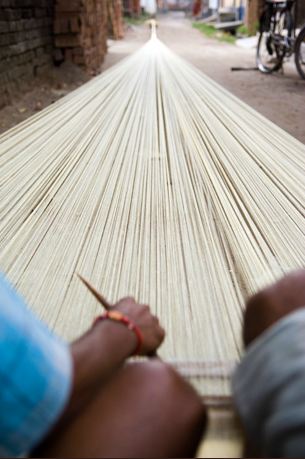
On top of creating impeccably stylish leather products they also have a smaller range of silk scarves. Above is a picture that I have taken from their heart-warming Heritage photogallery. It takes you through a lot of the production steps, such as the handloom weaving of the scarves as above. This spring they even did a collaboration with poet and artist Ron Ryan. You should check it out here.
You'd think with the quality, craftmanship and fairtrade principles of the company that the products would be incredibly expensive. Think again, the ladies' purses start around £15 and the ones above are only £45.
Please follow the blogathon by clicking the image below and enter the give-away on Twitter just by retweeting any tweet with the hashtag #ethicalfashionblogathon (details here).
Nomad Clothing
As part of today's blogathon I've been asked to write a little about Nomads Clothing. I feel in my heart and mind the same passion that so many other fantastic people do when they have visited India for the first time. Not uncommonly will this love express itself through an initiative to do good. This is of course what made Vicky and Duncan set up Nomads Clothing.
And what better choice than to trade rather than aid in garments? The clothing trade is one of India's largest exports and employers, and the variety of techniques and crafts in textiles is unimaginable.

Nomads Clothing use a lot of blockprinting which originates from Rajasthan (check my musings from my recent trip here). Especially the autumnal colours of this season evoke a stylish bohemian look, and although most of the collection consists of cosy daywear, if you style it right you can wear this comfortable collection throughout the day.
1. The Handloom Handbag is made from the very textile that Gandhi advocated would bring India independence. Craftsmen will use no electricity as they weave together around 1-1.2 metres of fabric per day, it takes patience and skill - two resources that only demand will help this craft survive.
2. With Nomads Clothing being experts in harem pants and printed leggings I knew there was going to be a perfect piece to feature. These Harem Trousers are sleek yet comfortably roomy and soft, perfect for those days when don't only want to look good, but also feel good. The embroidery at the hem brings this style exactly that extra pinch needed to make you able to wear this into the nights. Check out more about hoe Nomads Clothing helps keeping embroidery crafts alive on their website here.
3. The Short Skirt with a nicely autumn shaded blockprint with tree motives. With the super practical pockets you will never wander around wondering where to put your phone. More interestingly the technique of blockprinting is one of India's gems. Wooden blocks are cut out and coordinated according to the number of colours needed. Most costly are the 10-coloured fabrics that take weeks and weeks to produce. Each colour is printed individually and the printers have minute attention to detail as they press the block down with millimetre preciseness. When printing this style, I'm sure the printer enjoyed a few days of relaxed random pressing. I hope for any wearer of this skirt to think of him and smile as they look down at their gorgeous randomly printed trees.
Please follow the blogathon by clicking the image below and enter the give-away on Twitter just by retweeting any tweet with the hashtag #ethicalfashionblogathon (details here).
And what better choice than to trade rather than aid in garments? The clothing trade is one of India's largest exports and employers, and the variety of techniques and crafts in textiles is unimaginable.
Nomads Clothing use a lot of blockprinting which originates from Rajasthan (check my musings from my recent trip here). Especially the autumnal colours of this season evoke a stylish bohemian look, and although most of the collection consists of cosy daywear, if you style it right you can wear this comfortable collection throughout the day.
My 3 favourite picks from the collection
 |
| Handloom handbag, embellished hem trousers and blockprinted tulip skirt. |
2. With Nomads Clothing being experts in harem pants and printed leggings I knew there was going to be a perfect piece to feature. These Harem Trousers are sleek yet comfortably roomy and soft, perfect for those days when don't only want to look good, but also feel good. The embroidery at the hem brings this style exactly that extra pinch needed to make you able to wear this into the nights. Check out more about hoe Nomads Clothing helps keeping embroidery crafts alive on their website here.
3. The Short Skirt with a nicely autumn shaded blockprint with tree motives. With the super practical pockets you will never wander around wondering where to put your phone. More interestingly the technique of blockprinting is one of India's gems. Wooden blocks are cut out and coordinated according to the number of colours needed. Most costly are the 10-coloured fabrics that take weeks and weeks to produce. Each colour is printed individually and the printers have minute attention to detail as they press the block down with millimetre preciseness. When printing this style, I'm sure the printer enjoyed a few days of relaxed random pressing. I hope for any wearer of this skirt to think of him and smile as they look down at their gorgeous randomly printed trees.
Please follow the blogathon by clicking the image below and enter the give-away on Twitter just by retweeting any tweet with the hashtag #ethicalfashionblogathon (details here).
Ethical Fashion Blogathon
Ceri Heathcote of Style Eyes and the Ethical Fashion Bloggers is challenging herself and a group of ethical fashion bloggers (me included) to spread the word of better clothes for International Blog Action Day. Read all the details here. The most important thing is that there will be loads of interesting brands to read about and a give-away too.


Support
The Ethical Fashion Blogathon is supporting Naomi Hospice in memory of Naomi House Hospice. You can give your support here. Ceri has arranged for ethical and sustainable brands to each donate £30, and in turn us bloggers will write 250-300 words and showcase the best pieces from their AW12 collection.
Win
On top of all the good words we'll be spreading throughout today there's also a competition running. Just by following @Caipora_Jewelry and clicking retweet on tweets with the hashtag #ethicalfashionblogathon and each retweet will be an entry.

Subscribe to:
Posts (Atom)