Showing posts with label Exchange. Show all posts

Monday, April 8, 2013

Women hit back at India's rape culture

Being in India in that crucial period while the 23-year-old medical student was gang raped and struggling for her life in hospital was an experience that will stay with me forever. The general righteousness and fairness that i expect to meet in life is a prerogative. My sense of security in life stems from the fact that I was born and have grown up in a Western society where the law is reality. So many women live in a society where even if they do have the right of sexual consent or reproductive rights, the society or police will not act upon allegations with due respect to the woman.


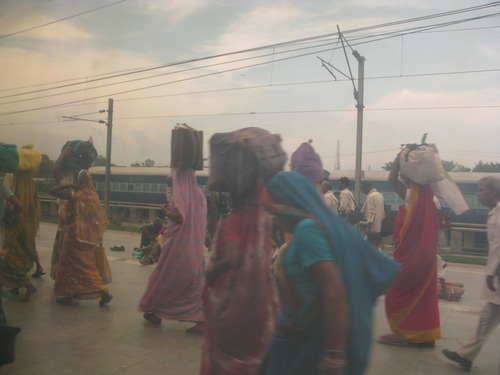
This is the story as I've gathered it from BBC and general articles around: The case of the student in the Delhi-rape was that she and her friend were walking around looking for an auto (tuk-tuk) outside the biggest mall Select City-Walk. Seeing as they were going far none of the drivers were willing to take them. This type of night time haggling is a pastime that you will end up spending a lot of time on if you decide to live in Delhi. Then they jump onto a bus - the decision that turned out to be the worst thing they could do. The driver had simply invited his friends for a ride after hours. It was a mistake of the couple to jump on that bus, and it was awful what those psychos did to her. But the awful thing doesn't end when they are kicked out of the bus. The scary part was for me to realise that naked, beaten up and blood streaming down their bodies they were running around the streets looking for help and not finding any. Auto's, taxis, trucks, people in their shiny white cars all refused to help them get to a hospital.

Getting involved in a case like this would take up your time and money - you could end up being suspect if you don't pay enough bribes with the way the Indian justice system malfunctions. When finally they manage to get hold of the police, the poor incompetent officers had to decide which hospital to bring the couple to. Because of the bureaucracy involved they couldn't bring her to the nearest (private) hospital, but had to take them to a propped government hospital with a queue that didn't exactly help getting her to a doctor any faster. The story shows that not only are there too many rapes happening in Delhi, but there is a profound fault with the justice system and bureaucracy involved even in emergencies.

The amazing thing that happened after the sad death of the victim December 29th was that women of all backgrounds started caring. They joined forces and told the men that they would no longer accept the treatment as sex objects any longer. I experienced how men would stare, lick their lips in lust and grope my privates as I passed by. I learned to lower my eyes and by New Years Eve I was prepared for the party scene in Goa where we accidentally ended up in a not-so-touristy club with way too many men. Twice in the first 15 minutes on the dancefloor i managed to grab the arm touching my ass and hit the guys. I seemingly got respect from that and as far as I remember the strangers left me to dance the night away with my friends.

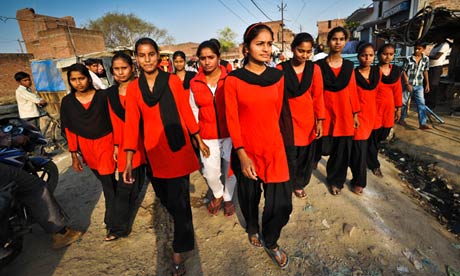
The Red Brigade is a group of women in Lucknow who has gathered to end sexual harassment and abuse by learning self-defence and exercise punishment of the local men. Now, I'm not in favour of taking the law into your own hands as the Red Brigade do when they beat up men. But upon the realisation that the police really is corrupt, that the legal system does not function and this is the only realistic option for these women I have come to the conclusion that it has to be the way of India's women. Women in India need to prove their strength and unison. Until the legal and bureaucratic system gets fixed, physical come-backs and threats will have to educate the men of India on women's worth.

Speaking of rights and in the terms of third wave feminism will not help in India. India will go through their own waves of feminism, and all feminists in the west can do is to look at this in awe and write long blogs about it. We can show our support and facilitate learning, but it's their own fight with a part of their own culture that we can only try to understand. The women need to learn their rights and the men who don't get it need to be retaliated upon. It's a fantastic new era for these women and their daughters.

Monday, October 29, 2012

Navratri Festivities in Gujarat

Last week I had one of my most exhilarating experiences ever. I went to Ahmedabad in Gujarat for Navratri, a festival celebrating that the goddess Durga fought a demon for 9 days and in the end succeeded because of her feminine strengths, I think. There's a wiki page here, but the most important thing is the Garba. The Garba ground is a massive circle where people dance the traditional steps back-and-forth-round-and-clap-back-and-forth-clap-step-back-step-forth.

My couchsurfing hosts told me that many of the women save up to this festival all year, spend months sewing their costumes, often with different outfits for each day. But not only the women dress up, the men are dressed in equal grandeur and have trained just as much. The most children in Gujarat are born 9 months after Navratri. The splendid dress and mesmerizing dancing creates an atmosphere out of the ordinary in an otherwise alcohol-free state.

So many of the women's outfits were breathtaking. And when you realise that all the colours are embroidered you feel like stopping them all from dancing so wildly and taking them all to a museum, but of course that would be a horrible idea. I was so inspired and in love with it all. We weren't allowed to bring in cameras, but fortunately nobody minded having their picture taken when I asked.


The girl in the first picture was an amazing 10-yearold girl who practically kidnapped me away from the people I went with. She showed me the steps and her friends laughed with me so hard at my clumsiness. I think several hours went by in an instant until her elder sisters joined. At one point we found a group of more than 20 men doing what can best be described as sit-up-dancing. They were sitting in a circle on the floor shaking their hands over their heads as they moved their upper bodies back and forth. We joined them and got a great work-out.


The event was live-streamed every day. If you want to see me catching a breath, I'm standing behind some dancing Europeans around 1h 34m into the clip above. In retrospect these videos are actually quite trippy, and I suggest you put them on to celebrate an epic Halloween party. Around 30min into the clip below we start chanting and praying. It was quite a magical moment as all the lights went off and we were left with the candles that we held in our hands.


After the days in Ahmedabad Indian Rails decided to mess a little with my tickets, and instead of going further into the countryside I went to Baroda. I spent my time there with a great couchsurfer who literally lives and works at night and sleeps in the day. He works with internet marketing, but is considering to become a tourist guide in the daytime. With his friends we went for Navratri celebration at the Fine Arts campus, Jalebis (traditional sweets eaten on the last day of Navratri), then a rooftop party. When all that was over he showed me Old Baroda and the vegetable market as the hustle and bustle of the city started just before sunrise.

The Fine Art students had taken clues from recent trends into their dresses that were more simplistic and there were no microphones. Just drums and the shrieks of their joy.

Sweet Jalebis are being cooked in pure ghee (clarified butter)

The vegetable market as it opens up to the vegetable wallahs who will sell these further in local markets.

Sunday, September 30, 2012

10 Reasons Why Factories Don't Pay A Living Wage (And Why They Suck)

Inspired by Ecouterre's recent article '10 Biggest Excuses For Not Paying A Living Wage (And Why They Suck)' I've decided to try and explain what I have seen and heard since I arrived here in India. There is an understanding that it is the multinational companies who pay the garment workers, when in fact it is relatively small manufacturers employing between 400 and 1,000 workers at each plant. To understand the wage system then, we can't forget the middlemen. These owners of the manufacturing units are the people squeezed between powerful corporations and penniless workers and rising raw material costs with an expectation to be making big time money.

Here are my first four reasons why factories don't pay a living wage (and why they suck)...

The entrance to a garment factory fully equipped with security and 'No Child Labour' signs

1. When a buyer places an order, she does so on the basis of the price

The fashion industry has built a system in which buyers can demand free product development services from the manufacturer in return for the prospect of an order. Therefore the buyer will ask several manufacturers to develop the same pattern for the same style, in the end she chooses only one. In theory it enables the buyer to choose the manufacturer with the best eye for detail and quality of product. Practically it only comes down to price. If the products are pretty basic in design it's all about being the manufacturer in the run who dares to go 5 cents lower than the rest. For more complex products the buyer will choose the best design and use the offer from the other manufacturer to exert pressure on the manufacturer to go cheaper. If the manufacturer continuously puts his prices too high, he will not receive these offers in the future.

It may seem ridiculous that a few pennies make such a big difference for a company. It certainly doesn't for the customer to whom adding 40p to the price is not a big deal; £4.99 or £5.39. But considering an order for a million t-shirts this increase is suddenly £400,000. Clothing retailers are holding on to their margins with sharpened claws these days all the while customers are becoming more and more price sensitive and increasingly waits for the sale. Buying clothes at discount only gives one message to the retailer: "I want my products cheaper". It doesn't exactly say: "I want your margins to be lower".

2. The workers are lucky enough to have a job

The most common excuse for not paying a living wage is that workers are already being paid the lawful minimum wage, or that they are lucky enough to be off the streets. And it's true. Garment workers are better off than the poorest part of the Asian population, and the producers of garments for exports to the West are even better off than the majority of garment workers altogether.

But that doesn't mean the situation fine. If development goes in the direction that even the outsourced workforce are paid a better price, then maybe fabric suppliers can start demanding decent wages and so the chain will expand. In the end the drivers and servants will be able to make enough money for their families. The vegetable sellers and all the merchants are inclined to gain better sales too. The prospect of the garment sector to influence the entire economic development of the region is massive. Every little payment of a decent wage is a promise of a future with less people in poverty. And that's why they are not just lucky enough to have a job; workers can become mediators of positive change.

 Just one of the many rooms in a very unorganised factory

3. If workers are paid too much they will become lazy

This is the most ridiculous argument that I have heard. Fortunately I haven't directly heard it from a factory owner, but the argument circulates as an example of bad leadership at my college. Some of my lecturers who studied ways to improve the health of embroidery workers found that giving them a simple angular table would enable them to save their backs. In their study of quality control workers they found that a bar stool would be significantly better for their legs and backs. However, the managers they approached were against the changes because the workers would become lazy. To date embroidery workers are still hunched over their work and quality control assistants are trying to rest their legs by standing on one leg at a time. This exemplifies what middle managers think of their workers; lazy and inefficient. It doesn't exemplify reality.

4. The wages are the only price factors that a factory owner can regulate

In the endless race to the bottom of prices (Reason 1) the buyers have decision power over so much that only the wages are left for the manufacturer to decide. When visiting a large manufacturer recently we asked what the most frustrating part of dealing with buyers was, and the answer was this: buyers sometime have the most ridiculous expectations of quality and embellishment levels combined with price offers that hardly pay for the lining. It's not possible for the manufacturer to cut low on the quality of fabrics as they have to be approved in several procedures - the trims and accessories too.

The only levitation left is investment of new machinery and wages. There are limits to both, but it's easy to see that a broken sewing machine works less than even a hungry worker.

Stay tuned on Twitter for the next 6 reasons of why factories don't pay a living wage...

Sunday, September 23, 2012

'Rocks That I've Got' Project Update

Today I finally managed to pay a visit to my landlord's factory. Before I left London I promised my friend Rafal Zajko that I would source costumes for a performance of his. The project involves digital printing which is a big part of my landlord's business, so it seemed a perfect match. As always in India though, things take time.


The above is one of the designs to be printed on fabric and then stitched into shirts and trousers. I was initially hoping to source organic cotton, but now it turns out that the non-organic cotton I'd bought was wrong anyway. The printing process needed for 100% cotton would include all sorts of chemical pre-printing and post-printing treatments, so it was decided that the sourcing department of the factory would manage to find the poly mixed fabric. The printing method we decided on is ink deposition, meaning that the ink goes into the fibres of the yarn, as opposed to film deposition which is that plastic piece melted onto cheap t-shirts.

The printing manager did some tests on fleece material. First the design is printed onto a piece of paper with a special coating.

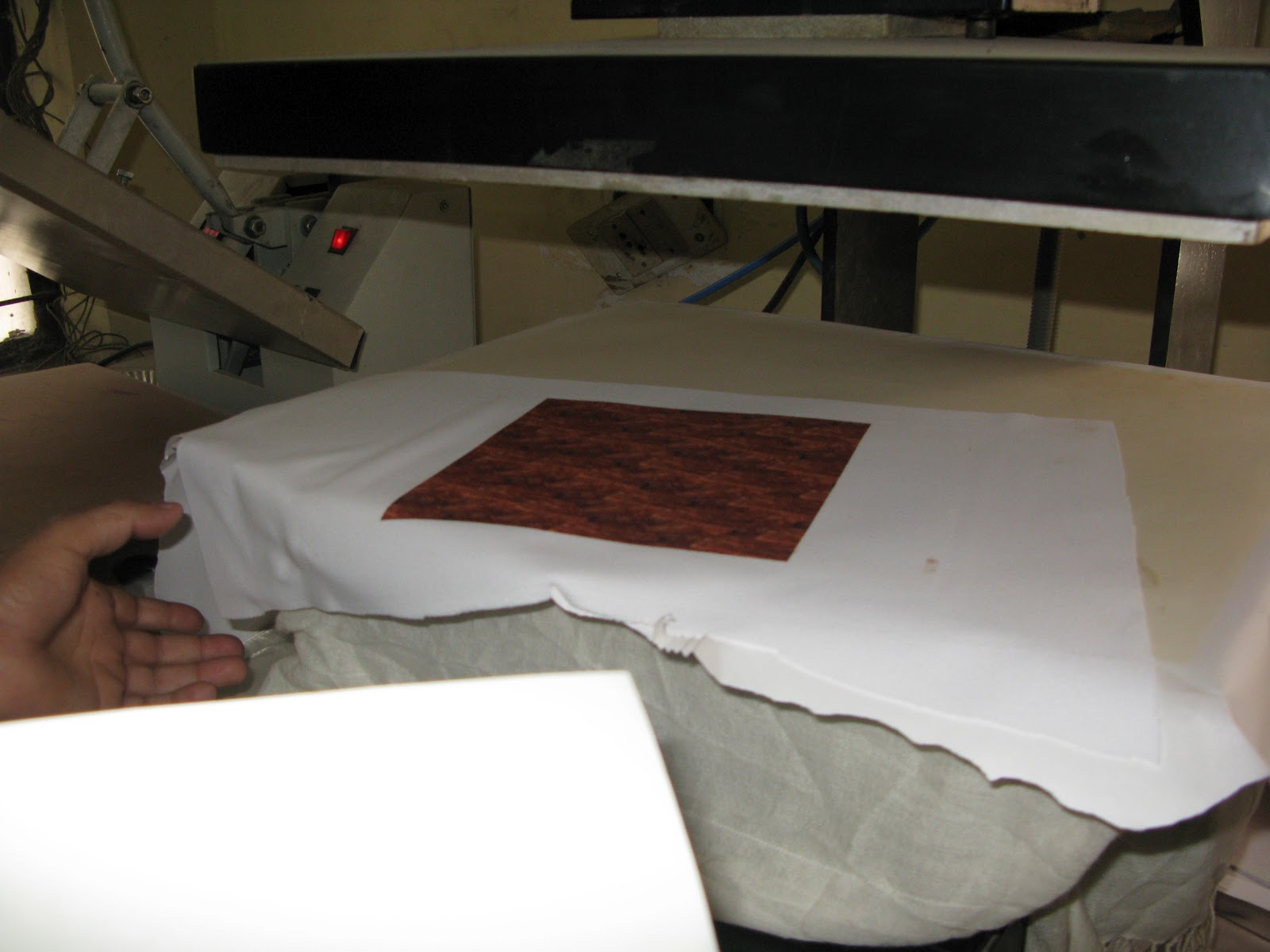
Then the paper is placed onto the fabric and the massive iron is pressed onto the fabric with a lot of pressure. The iron below is actually the smallest one in that room. Behind us, underneath a massive bunch of chiffon tops, there was an iron the width of fabric rolls.


When you remove the paper this is how it turns out. All the ink on the paper is gone, but the fabric is vivid.


Please cross your fingers that tomorrow I will have metres and metres of fabric to bring to a tailor. Meanwhile check out some of Raf's work.

Wednesday, September 12, 2012

The Perks of being a Wallflower

While in Chandigarh last week my friend Vikram decided to use the opportunity to rummage around his cousin's closet and her massive collection of accessories. He had been dying to style me in what sounded to me as hooker heels and bum-showing skirts, but he ended up using a lot of my own clothes in the end. The pictures are finally edited, and all my awkward poses deleted. Vikram has even written a spot-on description of me. It's all on his blog Sartorial Diary.


Thursday, August 23, 2012

Bad India Days

When I first arrived I was lucky enough that somehow the backpacking plans of a friend of mine from Denmark coincided with my arrival. She'd been travelling around for three weeks with her friends. She warned me that some days I would hate India, she said that in their little group they'd made it a joke to just say out loud "Bad India Day" whenever something was getting on their nerves.

Please allow me to share a few of my Bad India Day incidents. I really need to let go of it all...

So a few weeks ago my professor in manufacturing invites me to come along to a conference on Supply Chain Management because the CEO of a very interesting brand called Fabindia is going to speak. Fabindia is a fantastic initiative (I think) to build up a brand around traditional craftsmen. Of course it is criticised for not being fairtrade enough and it was a big thing when they stopped exclusively selling fabrics made on the handloom and began to offer powerloom materials. However, I decided to bunk college for two days for this conference, I bought a book written by the CEO and got myself ready.


So I arrive in this 5-star hotel through the rain, my auto-rickshaw wallah doesn't dare driving through the gates and I end up walking through the massive puddle by the gates. I get to the boardroom, register and get my programme. Mr. William Bissell is obviously nowhere to be seen on this. When later in the day I ask my professor he just does that funny Indian head-shake. Then I ask the person who arranged the thing and he explains angrily to me that it is not his job to make sure people come - it is only his job to invite them. So, the programme which was circulated before the conference started was listing all the people invited, not the confirmed speakers.


Oh well. Now I have a nice little badge to add to my travel diary and afterwards my professor introduced me to the most amazing market ever where I got myself a handloom weaved bed cover, a hand blockprinted sheet and a handpainted silk scarf. I promise you it was worth it.

Another weird thing about India is the lack of addresses. I was desperate to get my laundry done, so I asked  a friend about what to do. He drew a little map of our area and told me to get to Sinatan Dharun Temple. I could easily find a laundry wallah around there. Easily.

So I left my house and just to make sure I asked a guy on the road which way was to the Sinatan Dharun Temple. He gives me a puzzled look and explains to me that there are two temples by that name and they are both very close. So he asks if I am looking for the one in F-block or G-block. I have no idea because the people from class had all said that there are no addresses for these places. So I just decided on the F-block temple. I reach it and when someone from the temple understands that I'm not looking to buy flower necklaces, he takes me to a laundry place on the street. It's a group of people who built a little place outside, I talked to a woman who was ironing with the most ancient iron that I have ever seen. More ancient than the entire collection at Horsens town museum, I tell you. It was basically a container of red-hot burning coals. It is a sight that gave me several nightmares of her incidentally touching a corner of the synthetic lace on one of my shirts. We agreed a very cheap price (no bargaining needed there), and delivery at 8am. I was super happy that they had easily understood my address and I got someone's phone number and all.

This morning at 8.20am I decided it was time to get my clean laundry already and shower with the fresh clean towel and put on some fresh clean clothes. So I call up the dude and he tells me delivery will be 10am. No excuses, just that delivery will be at 10am. All day while in college the nightmare continues that I will be absolutely clothes-less because she touched that monster-iron onto my shirt and is too afraid to deliver back broken clothes. Thankfully though, at 2.30pm when I call to check a third time all the clothes had been delivered. The price had been adjusted of course, but it wasn't bad at all, and my clothes is kind of clean and kind of ironed.

Just one more incident and I think I'm fed up with writing. Several times I have wanted to take books out of the library. At first I still needed to get my id-card, then the desk had closed down without any notice and no opening hours stated anywhere - and then yesterday I finally understood that I had to pay a deposit to be able to do anything. So I managed to fill in the forms, bring the deposit money and get going today. It was a lengthy deal including 3 different offices and half an hour listening to the librarians discuss whether 5.000 rupees was enough or whether I had to go back and pay 10.000. By the end I managed to get all set up, so I approach the desk with the 3 books I'd reserved since yesterday. One was a reference book, fine. But that's when I lost my patience, because I can apparently only issue one book at a time for one week. I really don't know how I'll manage being a student here. LPEs here I come (that's short for Low Price Edition - the kind of book which can only exist in countries without copyright laws).

By the way. I need a friend called Joe to give this to, it's such a pretty note worth five pennies. Bad India Day is over. I think I'm okay now, maybe tomorrow I'll share some market finds with you.

Monday, August 20, 2012

Hauz Khas Village

I finally had time between settling into the new flat and all the work at Pearl to meet up with my sweetest friend Dhruv who I knew from London. He lives just near Hauz Khas Village which is the most adorable little area of New Delhi that I have yet seen. It's kind of boheme with cafés and restaurants scattered all over in small alleyways in an area which undoubtedly used to be the kind of claustrophobic un-organised Delhi housing that is just so romantic. We had a South-Indian lunch in Naivedyam, went shopping and then Dhruv took me by surprise to the nearby fort.

Graffiti outside Naivedyam

I bought this amazing necklace in one of the small boutiques.
I promise to get you pictures of the shopping area itself one day. I also need to spend some time there to fully investigate all the eco-friendly shops. I saw signs for People Tree and I know Fabindia is there, but more importantly there is a big concentration of the local shops which stock recycled and ethical fashion.


The night ended with more friends of the fashion world, beer and a Rajasthani singer serenading into the night. I don't want to spell names wrong, so today I can only introduce to you Vikram (far right). He also studies at Pearl Academy - Fashion Design in his final year. I really like the photos on his blog The Sartorial Diary so I'm looking forward to see his work.

Wednesday, August 1, 2012

Arrival

I arrived just 3 days ago to magical New Delhi. I am a little exhausted having contracted a cold and the lovely Delhi belly already on top of the jet-lag. So today it's just a quick picture update for you all.

 My sweet guide Swati, who I met in London when she was also an exchange.

 Kids around the lake by India Gate. There's so much street food, candy and toys to buy here. I was surprised at how few Westerners we saw.

 Our guides Swati and her friend had never driven past the residency of the politicians before. There was lots of nerves in the air and I was told to just shoot away quickly as we wouldn't be able to stop.

 It was fine and by the gate of the garden we joined many other vehicles just standing there for a little while.

 This pic is for my dad. Indians are crazy builders.

Signage on the metro to show the way to the Women's only carriage where you can avoid the stares of the men. I found it massively useful - much more than the metro map. I had to try and decipher which station I was at and where I was going in Hindi! I almost left Delhi before I realised that I was going in the wrong direction.

 Going home from uni today I saw loads of schoolchildren getting crammed into these mini-volkswagens. They managed to squeeze in more than twenty girls in this one.

Traffic is crazy, absolutely mad. Every day I take an autorickshaw with Samantha my fellow exchange student. But, maybe we should learn driving the Indian way?

Tomorrow is a day off from uni because of Rakshi. It's a festival to celebrate brothers of all kinds. Sisters and cousins buy knotted bracelets to tie around their brother and cousins wrists. Then the boys promise to protect their sisters and cousins al their lives and the families spend time together. I'll just try and sleep properly, go to a market to get water-proof shoes and uni books.